The Kitchen Garden Before the Supermarket
The kitchen garden before the supermarket varied by household and place. Learn how food, land and labour shaped its layout and where crops were grown.
The common mistake in imagining the kitchen garden before the supermarket is to treat it as one timeless design; that blurs the differences between households and regions. In England during the late medieval and early modern periods, domestic gardens ranged from modest plots beside dwellings to larger, organised grounds, shaped by available land, labour and local foodways. The phrase kitchen garden before the supermarket is useful only if we ask where and when a garden existed, and what its household needed from it.
English household gardens varied by place and period
In late medieval and early modern England, a kitchen garden was a cultivated area supplying a household with food and useful plants. It might be close to a cottage or town house, or form part of the grounds of a larger residence. Its size and arrangement depended on the household’s means, the land available and local growing conditions.
These gardens did not replace other ways of obtaining food. Grain, meat, fish and dairy could come from fields, livestock, fishing, trade or markets, while a garden supplied selected fresh ingredients and plants for household use. What it contributed changed with season and circumstance.
Herbs such as parsley, sage and mint could be gathered in small amounts. Cabbages, onions and root crops offered other kinds of food, while fruit trees, soft fruit and culinary flowers might occupy suitable ground. The mix was not identical from one household or region to another.
For historical interpretation, distinguish evidence about a particular place and period from a general possibility. A surviving garden plan, estate record or archaeological feature may show one arrangement, but it cannot by itself establish how all households gardened.
Three arrangements reflect different English household circumstances
There was no single plan for an English kitchen garden across the late medieval and early modern periods. A small plot with mixed planting, a divided kitchen plot and a larger garden combining fresh crops with crops for keeping are useful ways to compare possible arrangements, not fixed historical categories.
A small mixed plot used limited ground
In a modest domestic space, edible plants could share ground with flowers, fruit and useful herbs. A boundary might carry a fruiting shrub, while a sunny patch held herbs and vegetables. Mixing plants could make varied use of limited land, although it might make separate crop work less orderly.
This arrangement is a plausible way to interpret a small garden, but its presence should be checked against evidence for the particular household. A compact plot does not tell us by itself which plants grew there or who tended them.
A divided kitchen plot organised different crops
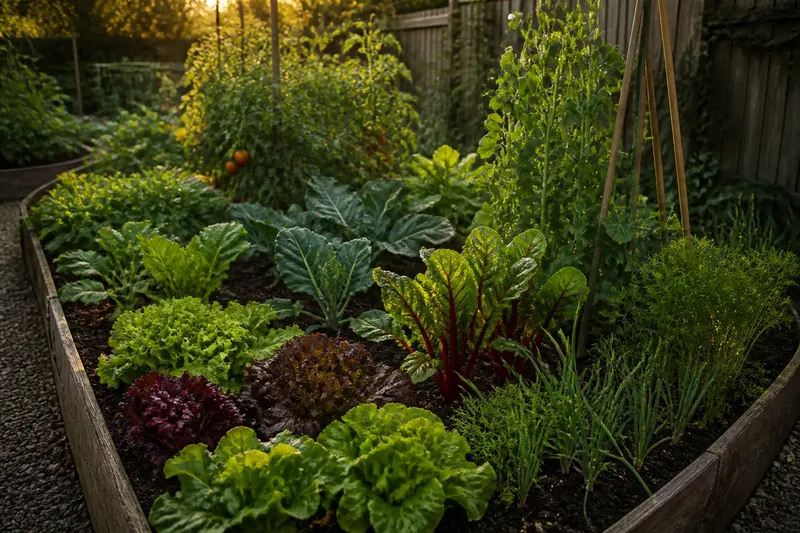
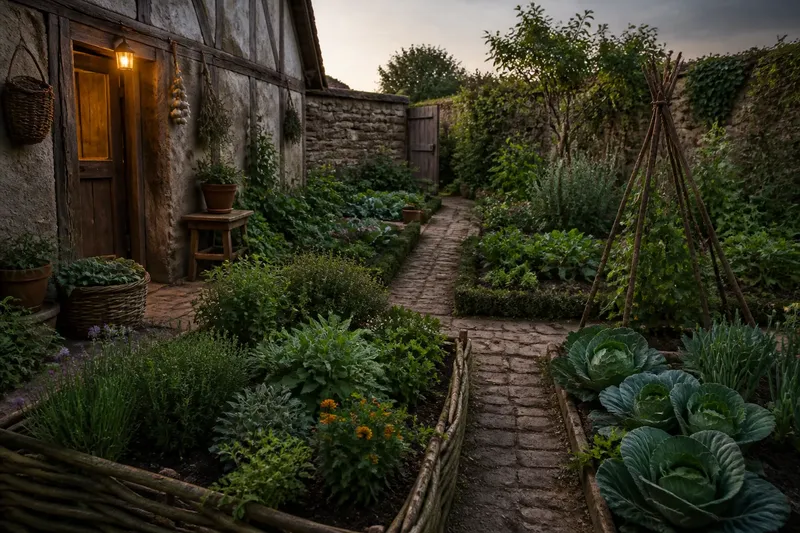
Where land and labour allowed, areas could be separated for vegetables, herbs or fruit. Beds and paths made it easier to reach plants without trampling cultivated ground, while a hedge or wall could mark a boundary and offer shelter.
Divisions could help organise tending and harvesting, but they required ground and ongoing work. A neat plan should not be assumed just because it seems orderly to a modern observer.
A larger garden could combine fresh food and crops for keeping
A household with more land and labour could place frequently gathered herbs or leaves near the house and keep larger areas for crops harvested in batches. Fruit trees or storage areas might be farther from the kitchen, connected by paths used to carry produce.
This arrangement highlights a practical distinction rather than a universal rule: a crop’s position could depend on how often it was gathered, its growing needs and how it was handled after harvest.
Convenience competed with growing conditions
Plants gathered often in small quantities had a strong claim to accessible ground. A cook could take a handful of herbs or a few leaves near the house, while a crop collected in a larger batch did not necessarily need the same proximity.
Yet the closest spot was not always the best place to grow something. Sun, soil, water access and shelter mattered, so a household had to balance ease of gathering against the conditions each plant needed.
Imagine an English household with a sunny bed beside its kitchen door, a sheltered strip against a wall and a larger patch beyond the yard. If its cook often used herbs, the household could plant them in the sunny bed; if a suitable crop benefited from shelter, it could occupy the wall-side strip; and if a vegetable was gathered in batches, the distant patch could serve it. The observable result would be a short route for small, frequent gatherings and a separate route for carrying larger harvests.
Paths and boundaries connected growing with household work
A hedge, wall or fence could mark a garden’s edge, help keep animals out or shelter plants from wind. In some settings, fruiting plants could also make use of a boundary. Which function mattered most depended on the site and the household.
Paths linked the house with beds and work areas. They offered a route for carrying tools, baskets and harvested food, and helped people reach crops without walking over cultivated soil. In a small plot, a simple route could connect the door and growing areas; a larger garden might need paths between distinct sections.
These features shaped more than appearance. They linked planting and tending with gathering, cooking and keeping food, while marking out how people moved through a working space.
What can a kitchen garden layout tell us?
Why might herbs have been planted near the house?
Herbs were useful in small quantities and could be gathered as needed, making a nearby patch convenient. Whether a particular household planted them there depends on evidence about that place and period.
Did every English kitchen garden feed a household on its own?
No single answer applies across late medieval and early modern England. Gardens supplied selected foods, while households also relied on other sources that varied with their means and circumstances.
Why might crops have stood farther from the kitchen?
A crop gathered less frequently or in larger amounts might not need the closest ground. Sun, soil, shelter and routes for carrying produce could also shape its position.
Were kitchen gardens always arranged in rows?
Some gardens may have used orderly beds or divisions, while compact spaces could mix plants. A plan or surviving feature should be read in its own context rather than treated as proof of one standard style.
Read a garden as evidence, not as a universal template
To interpret a kitchen garden before the supermarket, start with the specific place and period, then ask what the available evidence can support. A plan may indicate paths or divided plots; household records may mention produce or garden work; physical traces can offer evidence of boundaries. Each source has limits, so avoid turning one example into a rule for every English household.
- If a plan shows a short route between house and beds, infer convenient access as a possibility; if the plan’s date or purpose is unclear, avoid assigning that route a household use without further evidence.
- If records mention herbs gathered for cooking, consider a nearby herb patch as one plausible arrangement; if they do not locate the plants, leave their position uncertain.
- If a boundary appears in a map or surviving feature, consider whether it marked a garden edge or offered shelter; if its function is not documented, do not choose between those explanations as fact.
- If separate beds or plots are shown, consider whether crops were organised by use; if the plan does not identify crops, describe the division without naming its contents.
- If evidence points to a small plot, consider mixed planting as a way to use limited ground; if no planting record survives, present that as an interpretation rather than a confirmed practice.
- If a household’s resources are unclear, avoid assuming how much labour or land it could command; if records establish those conditions, use them to narrow the plausible layout.
For example, imagine a researcher examining a fictional early modern English household plan that shows a house, a walled plot and a path to two divided beds, but names no crops. The researcher first records only those visible features, then checks whether the plan’s date and purpose are stated; if they are, the researcher places the layout within that context, and if they are not, leaves the date open. Next, the researcher looks for household records mentioning produce or garden work; if herbs are named but not located, the researcher notes their presence without assigning them to a bed. The resulting interpretation is that the plan documents a bounded, divided garden with a path, while its crops and daily use remain uncertain.
The most useful reading of the kitchen garden before the supermarket keeps practical questions beside historical evidence: what could be gathered, how often, and how was it carried or stored? Those questions help explain why a particular layout may have made sense without turning one household’s garden into a model for all the others.