Why a Seed Needs Both a Start and a Pause
Seed dormancy explains why some seeds wait before sprouting. Learn to recognise the cues they need and choose a sowing method that avoids needless disturbance.
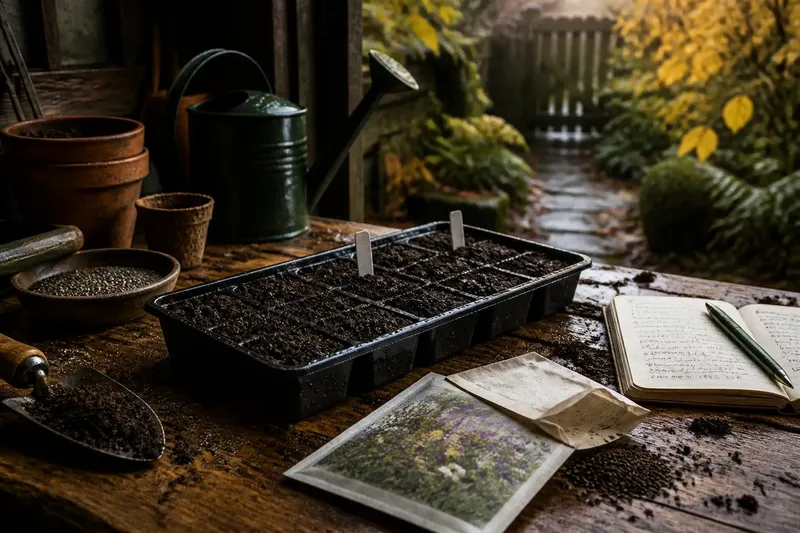
The most common mistake with seed dormancy is treating every seed that has not sprouted as a failed seed. That can lead to needless resowing or disturbed pots when the seed is still waiting for a particular cue.
Dormancy is a seed’s resting state: it is alive, but conditions for growth have not arrived, or an internal block has not yet lifted. It is a form of timing, not stubbornness. The pause can help prevent a seed from germinating during a brief spell of warmth or moisture that would be followed by conditions too harsh for a young plant.
Seed dormancy gives germination a sense of timing
Germination begins when a seed takes up water and the embryo inside resumes growth. The seed generally needs suitable moisture, oxygen and temperature. Some seeds respond when these conditions align; others also need a particular environmental signal or a change within the seed itself.
A seed packet’s instructions are a useful starting point, not a universal rule for every seed. One species may germinate readily after sowing, while another may remain dormant despite damp compost and a warm windowsill. Both responses can be normal.
In physical dormancy, a hard or water-resistant seed coat limits water uptake. In physiological dormancy, processes inside the seed prevent growth until the block eases. Some seeds have more than one barrier, so moisture alone may not be enough.
Cold, light and a firm coat can each change the timing
Cold stratification means giving seeds a period of cool, moist conditions to help release dormancy. Gardeners may use natural outdoor sowing or a controlled method described for the species. It is not simply chilling seeds: the combination and duration of conditions matter, and dry storage in a fridge is not the same as moist chilling.
Some seeds respond to light, while others germinate better in darkness or when covered. Do not guess sowing depth from seed size alone. A fine seed may need to remain near the surface, while a larger one may need covering; check the packet or a reliable species-specific guide.
Some hard-coated seeds need a treatment that softens or wears the coat. Scarification means carefully abrading or nicking a seed coat, but it is suitable only when the seed’s guidance calls for it. Doing it indiscriminately can damage the embryo.
Temperature also shapes germination. A seed that is ready may still wait if the compost is too cold or too warm for its species. When other conditions are right, a steady environment suited to the plant is more helpful than repeatedly moving a tray.
Work through a woodland wildflower sowing
Imagine you have a packet of woodland wildflower seeds. The label advises sowing outdoors in autumn, but you put a few seeds in a warm indoor propagator in spring. The compost stays damp, yet no seedlings appear. Adding water or moving the tray closer to a radiator may seem sensible, but neither action addresses the possibility of dormancy.
You check the species-specific instructions and find that the seeds need a cool, moist period before germinating. You leave the remaining seeds for autumn sowing in a labelled container, following the packet’s advice and keeping the compost from drying out. The expected observable result is a period without visible growth, followed by the possibility of seedlings when suitable conditions return.
This invented situation shows why the order of conditions can matter as much as the conditions themselves. A warm, damp start may suit one seed but be out of sequence for another. Identify the seed before changing the method.
Check the conditions before deciding to resow
A missing seedling does not reveal the cause on its own. Dormancy is one possibility; a dry seedbed, waterlogged compost, unsuitable temperature, poor viability or an unhelpful sowing depth are others. Each calls for a different response, so adding water or heat without checking can make matters worse.
- Check the packet for a named pretreatment; if it calls for cold stratification, provide the specified cool, moist conditions, and if it does not, do not chill the seed without another reason.
- Check whether the compost is dry; if it is, moisten it gently, and if it is already damp, avoid adding more water.
- Check whether water drains freely from the container; if compost is waterlogged, improve drainage or use a suitable container, and if it drains well, leave that condition unchanged.
- Check the sowing depth against the packet; if the seed is buried too deeply, adjust the method for any remaining seeds, and if the depth matches the instructions, do not disturb the sown batch.
- Check the container’s position against the species’ temperature guidance; if it is outside the stated range, move it to a more suitable place, and if it is already suitable, keep the position steady.
- Check whether the seed instructions specify light or darkness; if the current placement conflicts with them, correct it for future sowing, and if it matches, do not cover or uncover the seed without cause.
Keep a note of the sowing date and method. A plant label and a few words in a garden notebook, such as “surface sown” or “cool period”, can help you avoid repeating a treatment or disturbing a container too soon.
For unusual or valuable seed, follow the supplier’s directions and ask a knowledgeable seed supplier or horticultural adviser if the instructions are unclear.
Answers to common questions about seed dormancy
How can I tell whether a seed is dormant or dead?
Appearance alone rarely settles the question: a dormant seed can look much like one that will not germinate. Check the species’ guidance and the seed’s storage history, then use a small, separate sowing rather than disturbing the whole batch.
Does every seed need cold stratification?
No. Cold stratification suits certain species, but many garden seeds germinate without it. Use cool, moist conditions only when species-specific instructions call for them.
Can soaking seeds end dormancy?
Soaking helps some seeds take up water, but it does not remove every form of dormancy. A seed that needs cold, light, scarification or another cue may not germinate after soaking alone.
How long should I wait for seedlings?
Compare the time since sowing with the guidance for that species and the conditions in the container. If the expected window has not passed and the seedbed remains suitable, wait rather than resowing immediately.
Use seed dormancy to choose a suitable sowing method
Seed dormancy is easier to understand as a timing mechanism with different forms, rather than one problem with one solution. A seed may be waiting for cold, a change in its coat, light, warmth or the right combination of moisture and air.
For an unfamiliar packet, identify the species, note its stated cue and choose a sowing place that can provide it. That pause before sowing helps distinguish a seed that needs time from one whose growing conditions need attention.